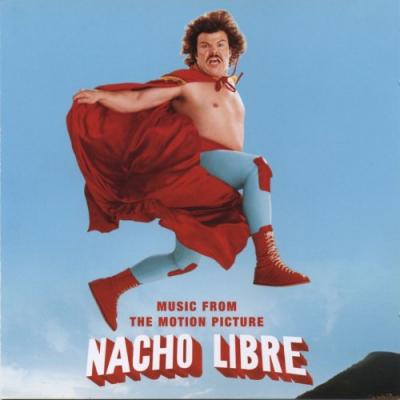
"Nacho Libre" Soundtrack Lyrics
Movie • 2006
Track Listing
Mr. Loco
Nacho
Alan Hawkshaw & Alan Parker
Mr. Loco
Jack Black with Ismael Garcia Ruiz Y Su Trio / for Ramses
Danny Elfman
Nacho & Esqueleto
Beck
Nacho
Beck
Caetano Veleso
Cholotronic
Eddie Santiago
John Cameron
Jack Black
Beck
Los Lobos
Nacho
Jack Black & Mucha Mucho Acapulco
"Nacho Libre (Music from the Motion Picture)" – Album Guide to Tracks and Key Scenes
Overview
What happens when a monk’s vow of humility collides with a soundtrack built for strutting in stretchy pants? Nacho Libre (Music from the Motion Picture) answers that with a mix of Mexican 70s pop, library lounge, alt-folk and wrestling fanfare that constantly pushes Ignacio toward showmanship, then yanks him back toward faith. The film tracks a simple arc — arrival, adaptation, rebellion, collapse — and the album mirrors each step with a different musical color.
The story follows Ignacio, a monastery cook and orphan who secretly dreams of becoming a luchador to feed “his” kids in the orphanage. As the film leans into broad slapstick and deadpan awkwardness, the soundtrack refuses to be background noise. “Hombre Religioso (Religious Man)” blasts through the opening credits while young Ignacio builds his homemade lucha collage, immediately setting the tone: spiritual words over a groove that practically begs you to jump off church furniture. Later, cues like “Ska Cha Chase” and “10,000 Pesos” push the film into sports-movie territory, with genuine underdog momentum peeking out from under the absurdity.
What makes the album stand out is the tug of war between two very different sensibilities. On one side there’s Danny Elfman’s punchy, slightly gothic orchestral material and John Cameron’s silky library track “Half Forgotten Daydreams.” On the other side there’s Beck’s fragile miniatures and Mister Loco’s ecstatic 70s pop. Together they score Ignacio’s double life: pious cook versus flamboyant luchador. Even when a track only plays briefly, the music keeps commenting on whether Nacho is acting out of ego, desperation or genuine love for the orphans.
Stylistically, the soundtrack moves in phases that line up with the story. Early sequences lean on 70s Mexican pop and bolero-inflected pieces — faith, innocence, and a slightly kitschy religiosity. Mid-film training and humiliation use surfy instrumentals, cumbia and a ska chase to give Ignacio’s struggle a playful, cartoon energy. As the plot darkens, Beck’s reflective songs and Elfman’s dramatic motifs underline doubt and sacrifice. Finally, the closing “Saint Behind the Glass” sits somewhere between folk hymn and road song, giving the ending a calm, bittersweet glow instead of a pure victory march.
How It Was Made
Behind the scenes, the score for Nacho Libre became almost as chaotic as the wrestling matches on screen. Director Jared Hess initially invited Beck to score the whole film, and the singer wrote a series of short, offbeat cues and songs tailored to Ignacio’s shabby spirituality — pieces like “10,000 Pesos,” “There Is No Place in This World for Me” and the unreleased “Holy Man.” When the studio worried Beck’s sensibility might not be big enough for a broad family comedy, they brought in Danny Elfman to record a full replacement score, which ended up supplying much of the orchestral backbone that you hear in the finished movie.
According to production accounts and later reporting, only about two-thirds of Elfman’s music actually made the final cut, with the rest of the film still built around Beck’s cues and source tracks. This created a credit dispute: Elfman’s team wanted a sole “Music by” line, while Hess insisted Beck should remain credited for the material he wrote. The compromise landed somewhere in the middle: Elfman is highlighted in official billing, while end credits and the released album credit multiple contributors, including Beck, Elfman, Los Lobos, Mister Loco and Jack Black himself.
The album itself — Nacho Libre (Music from the Motion Picture) — came out in late October 2006 on Lakeshore Records as a 19-track compilation running about 45 minutes. Later, it reappeared as a limited double-LP, translucent blue vinyl edition from boutique label Phineas Atwood, aimed squarely at collectors who had turned the film into a cult object. The LP and digital releases all highlight the same core roster of artists, though some tracks heard in the film, like “Mucha Muchacha” or Beck’s “Holy Man,” never made it onto the official CD or vinyl.
A big part of the soundtrack’s flavor comes from Mister Loco, a Mexican band whose 70s recordings Beck reportedly recommended to Hess. Their song “Hombre Religioso (Religious Man)” predates the film by decades but feels custom-made for Ignacio: the lyrics celebrate devotion while the beat makes you want to climb the ropes. Older tracks such as Los Lobos’ “Saint Behind the Glass” and John Cameron’s “Half Forgotten Daydreams” were licensed from earlier albums and library catalogs, giving the film that oddly “found” quality — like you’ve stumbled into someone’s lovingly curated crate-digger mixtape rather than a standard studio score.
Tracks & Scenes
“Hombre Religioso (Religious Man)” — Mister Loco
Where it plays: Over the opening credits, early in the film (roughly 0:01–0:04), young Ignacio raids church cupboards for fabrics and relics, assembling a homemade luchador outfit in his tiny room. The camera cuts between the orphanage’s hushed halls and this private ritual of cape-building, the song’s joyful chorus bouncing against the solemn imagery. Later in the film it returns during key hype moments leading into big matches, effectively becoming Nacho’s unofficial theme.
Why it matters: The track sets up the entire movie’s tone in one move — spiritual language over funk-inflected pop. It tells you this is a story about faith, but not told in a pious register. It also anchors Ignacio’s “arrival” as a would-be hero long before he ever steps into a professional ring.
“Ska Cha Chase” — Andrew Gross
Where it plays: During a mid-film training montage, around the second act, when Nacho and Esqueleto tear through town on a wheezing scooter. They crash into market stalls, practice holds on each other in dusty fields and try to psych themselves up for tougher competition. The cue is non-diegetic, cutting across several short vignettes over roughly a minute of screen time.
Why it matters: The ska rhythm and horn stabs give the film that classic “we’re getting serious now” sports beat, but the tempo is just manic enough to underline how incompetent the duo really is. It marks the adaptation phase — Nacho trying to live as a luchador, even if badly.
“Piel Canela / Singing at the Party” — Jack Black with Ismael Garcia Ruiz y Su Trio
Where it plays: At Ramses’ lavish party, when Nacho sneaks in disguised as part of the mariachi-style band. The cue is diegetic: Nacho literally sings at the microphone, warbling about how he is “singing at the party” while Ramses and his hangers-on listen with varying levels of boredom and confusion. The scene runs a couple of minutes around the middle of the film, cutting between Nacho’s over-earnest performance, Ramses’ expressionless face and Esqueleto raiding the buffet.
Why it matters: Musically, it’s the soundtrack at its most meta — a song inside the film about singing inside the film. It underlines Nacho’s need to be noticed by Ramses and Sister Encarnación, and the way his vanity sneaks in disguised as worship or flattery.
“Half Forgotten Daydreams” — John Cameron
Where it plays: At Ramses’ party again, in a later stretch of the same sequence. The music shifts into this ultra-smooth, almost syrupy library instrumental as Candidia seduces Esqueleto by the poolside while Nacho stumbles through the party’s social hierarchy. The cue plays non-diegetically over flirting, slow-motion glances and uncomfortable reaction shots, for close to a minute of screen time.
Why it matters: The track was originally written in the 1970s for a British library label, and here it becomes the film’s unofficial “sexy but deeply awkward” theme. It pokes fun at both the melodrama of telenovela romance and Esqueleto’s total lack of suave.
“10,000 Pesos” — Beck
Where it plays: Late in the film, near the final act. Nacho announces, in front of the church and the assembled monks, that he will win ten thousand pesos and buy the orphans a bus for field trips. His “I’m serious!” speech around the 1:03 mark gives way to Beck’s cue as we cut into preparation for the decisive lucha battle. The music is non-diegetic, tying together shots of the arena, Ramses’ preparation and the orphans’ anticipation.
Why it matters: It’s one of the clearest moments where the soundtrack stops winking and just commits to earnest underdog sports emotion. The piece is brief, but it marks the transition from rebellion (Nacho wrestling in secret) to collapse and exposure — and then to a more honest version of his dream.
“Encarnación” — Jack Black
Where it plays: Nacho’s courtyard serenade to Sister Encarnación after he has been exiled to the wilderness. He returns to the monastery at night, guitar in hand, and sings a wildly sincere, badly rhymed love song up to her window. The song is diegetic, captured in medium shots and close-ups over roughly two minutes, with little ambient sound besides crickets and Nacho’s voice.
Why it matters: The scene is comedy, but the music does real character work. The melody is overly grand for a love he is not supposed to admit, and his performance keeps slipping between genuine longing and theatrical rock-god affect. It spells out the conflict between his vow and his desire more clearly than any line of dialogue.
“Ska Cha Chase” & “Bubble Gum” — Andrew Gross / Mister Loco
Where it plays: Smaller beats throughout the film’s midsection. “Ska Cha Chase” underscores scooter chaos and slapstick training; “Bubble Gum” and other Mister Loco cues pop up as Nacho and Esqueleto move through town and the markets, sometimes in the background of crowded streets, sometimes foregrounded when Nacho’s inner monologue seems to swell.
Why it matters: These tracks fill out the world beyond the ring. They make Oaxaca feel like its own musical ecosystem rather than a generic background, and they reinforce that Nacho’s fantasy life is stitched together from whatever old records and radio songs he grew up with.
“Saint Behind the Glass” — Los Lobos
Where it plays: In the final bus sequence after the climactic fight, when Nacho has bought the orphans a big blue bus and they ride out to the countryside. Nacho drives, Sister Encarnación sits near the front, and the children cluster around the windows, basking in their hero’s victory. The song plays non-diegetically across the whole epilogue, about two minutes near the end credits, its mix of slow vocal lines and brisk rhythmic undercurrent matching the bittersweet farewell tone.
Why it matters: This is the collapse-and-transcend phase. The film doesn’t end on a triumphant stadium anthem; instead, this quasi-folk hymn suggests that Nacho has found a new balance between calling and ego. The music is both joyous and a little contemplative, which is exactly where the story leaves him.
“Mucha Muchacha” — Esquivel
Where it plays: Briefly in one of the goofier interludes — notably in a bike sequence and some quick-cut comedic moments where Nacho moves through town. It’s a hyped-up, brassy track that acts almost like a sonic punchline when paired with Jack Black’s physical comedy.
Why it matters: This track does not appear on the main OST, but it has become part of the movie’s online meme identity. It shows how much of the film’s charm comes from crate-dug instrumentals that feel just a little too stylish for the silliness on screen.
Notes & Trivia
- Beck was originally hired as sole composer, with Elfman brought in later for a more conventional score. The final film uses a hybrid of both, plus older licensed tracks.
- Mister Loco’s “Hombre Religioso (Religious Man)” is a mid-70s song that pre-existed the film; it became so closely tied to Nacho Libre that it’s often misremembered as being written for it.
- John Cameron’s “Half Forgotten Daydreams” started life as a library-music cue, not as a film theme, and has since become a minor cult favorite because of this movie.
- The Japanese release of Nacho Libre uses a different theme song altogether, “Go! Go! Carlito” by Jonny Jakobsen, which never appears on the main international album.
- There are more songs in the film than on the OST: tracks like “Mucha Muchacha,” “Bubblegum,” “Holy Man” and “Bat Macumba” are movie-only in official terms.
- Jack Black sings multiple times in character — “Singing at the Party,” “Encarnación” and “Forbidden Nectar” — which means a decent chunk of the album is essentially diegetic performance captured straight from the film’s narrative.
- The vinyl reissue turned the soundtrack into a Record Store Day–style collector’s item, pressed on translucent blue double LP and marketed heavily on its “cult classic” status.
Music–Story Links
The soundtrack repeatedly underlines that Ignacio is torn between humility and spectacle. “Hombre Religioso” blares over both his childhood costume-building and his adult runs toward the ring, linking his show-off impulses directly to his ideas about serving God. The same groove that makes you want to dance is the one that convinces him wrestling might be a legitimate ministry if he squints hard enough.
At Ramses’ party, the contrast between “Singing at the Party” and “Half Forgotten Daydreams” maps neatly onto two different social climbs. Nacho’s song is desperate, loud and transparently needy — he wants Ramses to acknowledge him and Sister Encarnación to notice his pain. Immediately afterward, Cameron’s velvety instrumental coats Candidia’s pursuit of Esqueleto in suave romance that neither of them really deserves. The music is fancier than the characters, which is the joke.
The Beck cues tend to appear at moments when Nacho questions his path. “10,000 Pesos” and “There Is No Place in This World for Me” aren’t used as big spotlight songs; they play under transitional sequences and quiet resolve, nudging the story away from pure parody and toward something like a genuine crisis of vocation. They support the rebellion and collapse phases, when Ignacio has to admit who he really is to the brothers and the orphans.
Finally, “Saint Behind the Glass” reframes the entire lucha arc. By the time the bus is rolling through the countryside, we’re not hearing crowd noise or championship fanfare; we’re hearing a piece rooted in folk and devotional traditions. The track gently insists that the real “win” isn’t the belt, it’s the orphans sitting in the seats behind Nacho — literally, the saints behind the glass windows of the bus, instead of on church walls.
Reception & Quotes
While the film itself drew mixed reviews on release, the soundtrack has quietly built a reputation as one of those “weirdly good” comedy scores that outperforms its source. Over time, critics, bloggers and fans have singled out the album’s crate-digger sensibility and the unlikely blend of Beck, Elfman, Mister Loco and Los Lobos as a key reason the movie remains rewatchable.
Some commentary has focused on how carefully the cues are slotted into what could have been a throwaway studio comedy. One writer argued that the selection “works because the songs never just decorate the scene; they tilt it slightly, making every gag feel stranger and more specific.” Others point out that tracks like “Black Is Black,” “Ska Cha Chase” and “Half Forgotten Daydreams” give the film a rhythmic spine that the joke-writing alone could not provide.
Fan conversations, especially among Beck listeners, often zero in on the short original pieces. Several posts treat “10,000 Pesos” and “There Is No Place in This World for Me” as minor cult songs in his catalog, precisely because they were written to serve a character rather than a standalone album. The Lakeshore release and subsequent vinyl pressings are generally described as solid-sounding, with few complaints about mastering or pressing quality.
“Songs like ‘Black is Black’ and ‘Ska Cha Chase’ are the perfect tone and pace this movie needs.” — Trinity Tripod, campus review
“The soundtrack of Nacho Libre was actually pretty good… music that enhances the experience and induces emotions instead of sitting in the background.” — student blog
“One of my personal favorites, ‘Half Forgotten Daydreams,’ works so well as the uncomfortable love theme between Esqueleto and Candidia.” — personal essay
“This soundtrack features original music from Beck and Danny Elfman alongside Los Lobos, Caetano Veloso and Jack Black himself.” — label marketing copy
Interesting Facts
- The soundtrack album and the film’s full music roster don’t match: several cues heard prominently on screen remain officially unreleased or scattered across older records.
- “Half Forgotten Daydreams” comes from a 1970s library LP and has since been reused in internet memes and playlists precisely because of its Nacho Libre association.
- Los Lobos’ “Saint Behind the Glass” predates the film by more than a decade and was originally released on their 1992 album, making its use here a form of sonic time travel.
- Mister Loco’s involvement reintroduced listeners to a band that had won a major song festival in Tokyo back in the 1970s; the film effectively revived their global visibility.
- Record-store descriptions of the vinyl reissue lean heavily on the “multi-award winning artists” angle, using the names Beck, Elfman, Los Lobos and Caetano Veloso to sell a very oddball comedy.
- Japan’s “Go! Go! Carlito” theme shifts the marketing tone there toward straight-up pop, which fits local promotion practices but gives that release a slightly different musical identity.
- Several fan playlists online try to reconstruct a “complete Nacho Libre soundtrack” that includes library cues, Mexican golden-age tracks and Beck outtakes alongside the official OST.
- Lakeshore Records later promoted the album again in a “Free Music Fridays” piece, treating it as a summer soundtrack — an interesting frame for a film set largely in dusty courtyards and wrestling arenas.
Technical Info
- Title: Nacho Libre (Music from the Motion Picture)
- Film: Nacho Libre (2006, US–Mexico sports comedy directed by Jared Hess)
- Year of soundtrack release: Late October 2006 (sources list October 24 and October 31 for different territories/editions)
- Type: Feature film soundtrack / compilation album
- Main contributors: Danny Elfman (score), Beck (songs and cues), Mister Loco, Los Lobos, Caetano Veloso, John Cameron, Jack Black (vocals and co-writing on diegetic songs)
- Label: Lakeshore Records (original CD/digital); later 2×LP vinyl via Phineas Atwood
- Format & length: 19 tracks, ~45 minutes (CD/digital); expanded packaging for 2×LP
- Notable placements on album: “Hombre Religioso (Religious Man),” “Encarnación,” “10,000 Pesos,” “Saint Behind the Glass,” “Black Is Black,” “Half Forgotten Daydreams”
- Music supervision / selection: Combination of new score commissions, Beck-written cues and licensed catalog material (library tracks, older Mexican and Latin American recordings)
- Availability: Widely available on major streaming platforms; physical copies circulate as original CD, later repressings and a collectible translucent blue double-LP
- Chart notes: No major mainstream chart run, but the album is frequently cited in fan and critic lists of unexpectedly strong comedy soundtracks.
Questions & Answers
- Is the Nacho Libre soundtrack mostly original score or existing songs?
- It’s a hybrid. Danny Elfman provides much of the orchestral score, Beck contributes short original songs and cues, and the rest draws on earlier recordings by Mister Loco, Los Lobos, John Cameron and others.
- Why are some songs from the movie missing on the official album?
- Licensing and album-length limits. Tracks like “Mucha Muchacha,” “Bubblegum” and Beck’s “Holy Man” play in the film but were never included on the core Lakeshore CD/LP, so fans usually add them via separate releases or playlists.
- Who actually “scored” the film — Beck or Danny Elfman?
- Both. Beck wrote an initial set of cues, Elfman was hired to deliver a fuller replacement score, and the final mix uses substantial portions of each, plus licensed songs. Credits and billing reflect that compromise rather than a single-author score.
- What song plays over the opening credits and the climactic lucha moments?
- The opening credits use Mister Loco’s “Hombre Religioso (Religious Man),” while late-fight buildup leans on cues like Beck’s “10,000 Pesos” alongside Elfman’s “Ramses Suite” and reprises of “Religious Man.”
- What’s the piece over the final bus scene with the orphans?
- That closing epilogue is scored with “Saint Behind the Glass” by Los Lobos, giving the ending a grounded, slightly devotional mood instead of a pure victory anthem.
Canonical Entities & Relations
| Subject | Relation | Object |
|---|---|---|
| Nacho Libre (film, 2006) | is directed by | Jared Hess |
| Nacho Libre (film, 2006) | stars | Jack Black as Ignacio “Nacho” |
| Nacho Libre (Music from the Motion Picture) | is soundtrack to | Nacho Libre (film, 2006) |
| Nacho Libre (Music from the Motion Picture) | is released by | Lakeshore Records |
| Danny Elfman | composes score cues for | Nacho Libre (film, 2006) |
| Beck | writes songs for | Nacho Libre (Music from the Motion Picture) |
| Mister Loco | performs | “Hombre Religioso (Religious Man)” on the soundtrack |
| Los Lobos | performs | “Saint Behind the Glass” on the soundtrack |
| John Cameron | composes | “Half Forgotten Daydreams” used in the film |
| Paramount Pictures | distributes | Nacho Libre (film, 2006) |
| Nickelodeon Movies | co-produces | Nacho Libre (film, 2006) |
Sources: Wikipedia (film & music sections), MusicBrainz, Lakeshore Records and retail listings, soundtrack databases, fan essays and blogs, MoviesOST.com, IMDb soundtrack credits.
November, 16th 2025
A-Z Lyrics Universe
Cynthia Erivo Popular
Ariana Grande Horsepower
Post Malone Ain't No Love in Oklahoma
Luke Combs Good Riddance (Time of Your Life)
Green Day Bye Bye Bye
*NSYNC You're the One That I Wan
John Travolta & Olivia Newton-John I Always Wanted a Brother
Braelyn Rankins, Theo Somolu, Kelvin Harrison Jr. and Aaron Pierre The Power of Love
Frankie Goes to Hollywood Beyond
Auli’i Cravalho feat. Rachel House MORE ›