
"The Barkleys of Broadway" Soundtrack Lyrics
Musical • 1996
Track Listing
"The Barkleys of Broadway (Original Motion Picture Soundtrack — Film 1949; key reissues 1981/1996–97/2011)" – Album Guide to Tracks and Key Scenes
Overview
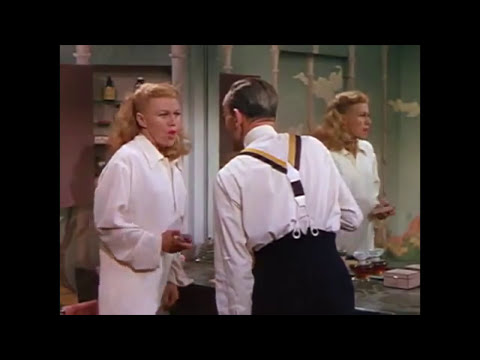
How do you write a valentine and a backstage roast at the same time? This soundtrack does both. The Barkleys of Broadway reunites Fred Astaire and Ginger Rogers—now in shimmering Technicolor—and lets songs by Harry Warren (music) and Ira Gershwin (lyrics) trace a bickering couple back to bliss. Then, with a single, devastating revival—“They Can’t Take That Away from Me”—it folds their shared legend into the story.
On screen (1949), the Arthur Freed unit’s arrangements move like stage machinery: quick scene-changes of rhythm and color, witty patter exploding into full production. On album, later reissues (LPs, box sets, and a compact digital program) preserve the arc: opener “Swing Trot,” novelty dazzler “Shoes with Wings On,” Oscar Levant’s show-off classics, and the Central Park balm of that Gershwin standard. You can hear the satire soften into sincerity.
Genres & themes in phases: urbane revue swing — creative friction presented with a wink; novelty tap & effects — showbiz problem-solving as spectacle; concert-showpiece interludes — ego and virtuosity; ballroom nocturne — forgiveness; Broadway uplift — the creed that keeps troupes together. Translation: reeds & brass = banter; tap & percussion = stubbornness; strings at hush = truth told gently.
How It Was Made
Directed by Charles Walters for MGM’s Freed Unit, the film features songs by Harry Warren and Ira Gershwin (their lone feature-length collaboration), plus a revival of George & Ira Gershwin’s “They Can’t Take That Away from Me.” Lennie Hayton served as music director; choreography comes via Robert Alton with Hermes Pan. Among the set pieces: Fred’s special-effects showcase “Shoes with Wings On,” crafted with then-cutting-edge compositing to make footwear dance by themselves.
Soundtrack availability is scattered across eras: a vintage LP appeared in the early home-video age; a run of Rhino/TCM anthologies in the 1990s restored and contextualized MGM-musical cues; then compact digital albums surfaced in the 2000s–2010s (often ~11 tracks), keeping the film’s musical spine in circulation.

Tracks & Scenes
Not a full tracklist. Below are the defining numbers, how they play on screen, and why they matter—album inclusions vary by edition.
“Swing Trot” (music by Harry Warren, lyrics by Ira Gershwin)
- Where it plays:
- A curtain-raiser: credits roll over a brisk orchestral-dance curtain that throws us into the Barkleys’ world. The cut snaps right into opening-night bustle.
- Why it matters:
- States the show’s tempo — urbane, forward, a little sly. Dance critic Arlene Croce once called it the film’s best number; on record it’s a perfect prologue.
“You’d Be Hard to Replace” (Warren/Gershwin)
- Where it plays:
- Post-show banter that turns into a tune. The melody smiles while the lyric politely jabs, and the orchestra punctuates a marital negotiation in 32 bars.
- Why it matters:
- Comic pas de deux in song — it’s flirtation disguised as contract talk.
“Bouncin’ the Blues” (Harry Warren)
- Where it plays:
- Tap-forward specialty: Astaire rides a bluesy swing riff, feet as drum kit, rehearsal room into dance floor. Minimal props, maximal phrasing.
- Why it matters:
- Blueprint-level Astaire — groove, phrasing, and musical wit without distraction.
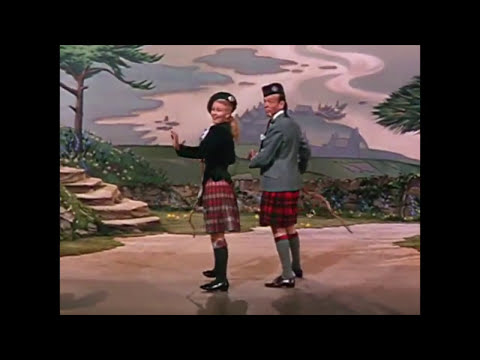
“My One and Only Highland Fling” (Warren/Gershwin)
- Where it plays:
- Scottish spoof inside the show-within-the-show — kilt gags, comic lifts, and a tune that loves its own pastiche. Rogers matches Astaire jab-for-jab.
- Why it matters:
- Proof the team still syncs even while the characters drift apart.
“Weekend in the Country” (Warren/Gershwin)
- Where it plays:
- Trio lark for Astaire, Rogers, and Oscar Levant. Light-footed patter pushes plot as the arrangement hops through key changes like a country gate.
- Why it matters:
- Shows Comden & Green’s backstage satire working in harmony with the pit.
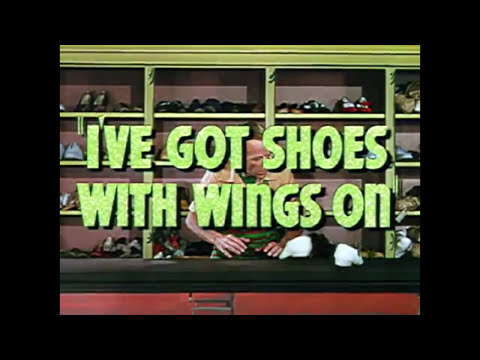
“Shoes with Wings On” (Warren/Gershwin) — effects showpiece
- Where it plays:
- Astaire, cobbler-by-night, in a solo fantasy where empty shoes come alive. Composited layers make racks, boots, and tap shoes dance with him in perfect time.
- Why it matters:
- Cinematic choreography: an effects pioneer wrapped in an earworm.
Classical interludes (Oscar Levant solos)
- Where it plays:
- Levant’s high-wire turns—Khachaturian’s “Sabre Dance,” an abridged Tchaikovsky Piano Concerto—drop concert bravura into a musical-comedy frame.
- Why it matters:
- Comic ego and virtuosity; on album they reset the ear between tap storms.
“They Can’t Take That Away from Me” (George & Ira Gershwin) — revival duet
- Where it plays:
- Twilight waltz in Central Park. This time they don’t just sing it — they dance it. Long lines, soft string writing, and a camera that refuses to interrupt.
- Why it matters:
- The emotional summit. A 1937 goodbye-song becomes, at last, a danced reconciliation.
“Manhattan Downbeat” (Warren/Gershwin)
- Where it plays:
- Company pep and bustle for the last stretch—press, critics, opening-night nerves. A bright send-off cue that hustles the story to the curtain line.
- Why it matters:
- Backstage anxiety solved, by rhythm — the credo of MGM musicals.
Notes & Trivia
- It’s the only Fred-and-Ginger film in Technicolor and their sole MGM pairing; all their earlier hits were at RKO.
- Warren/Gershwin wrote the score; “They Can’t Take That Away from Me” is the George & Ira Gershwin standard revived from Shall We Dance (1937) — this film finally lets them dance it.
- “Shoes with Wings On” used compositing tricks to animate empty shoes—a favorite Astaire effects number.
- Three Warren/Gershwin songs were prepared but dropped: “The Courtin’ of Elmer and Ella,” “Natchez on the Mississippi,” and “Poetry in Motion.”
Reception & Quotes
Viewers and critics long tagged the film as a graceful reunion with sneaky depth; the musical numbers—especially the park duet and the shoe ballet—carry the character arc more honestly than the barbs do.
“A reunion that remembers how to breathe between the jokes.” Modern criticism roundup
“When the shoes fly, cinema grins.” Fan shorthand for the effects number
Availability: cues appear on MGM/TCM/Rhino anthologies and compact digital albums; legacy LP and CD issues also circulate among collectors.
Interesting Facts
- One-off team: Warren & Ira Gershwin’s feature-length collaboration is unique in MGM history.
- Meta move: Reviving a 1937 Gershwin song inside a 1949 MGM show lets the film “quote” their past while writing a new ending.
- Effects lineage: Astaire had chased camera and effects experiments since the 1930s; the shoe routine is a late-period peak.
- Concert comedy: Levant’s classical inserts aren’t filler — they needle the egos in the room.
- Reissue patchwork: No single, definitive all-in-one OST dominates; instead you’ll find LPs, box sets, and short digital albums covering the essentials.
Technical Info
- Title: The Barkleys of Broadway — Original Motion Picture Soundtrack (film 1949; various album programs)
- Year given: “0000” (unspecified). Canonical film year: 1949
- Type: Film musical soundtrack (songs + underscore; later reissues/compilations)
- Music/Lyrics: Harry Warren (music); Ira Gershwin (lyrics) — plus “They Can’t Take That Away from Me” by George & Ira Gershwin
- Music direction: Lennie Hayton (MGM)
- Choreography: Robert Alton; associate choreography by Hermes Pan
- Notable numbers: “Swing Trot,” “You’d Be Hard to Replace,” “Bouncin’ the Blues,” “My One and Only Highland Fling,” “Weekend in the Country,” “Shoes with Wings On,” “They Can’t Take That Away from Me,” “Manhattan Downbeat”
- Album history (selected): 1981 MGM LP issue (highlights); mid-1990s TCM/Rhino anthologies featuring film mixes; 2011 compact digital album (≈11 tracks)
Questions & Answers
- Why does this soundtrack show up under different years?
- Because releases are reissues/anthologies. The music originates in the 1949 film; notable album programs arrived in 1981, the 1990s (Rhino/TCM sets), and 2011 digital.
- Who actually wrote the songs?
- Harry Warren (music) and Ira Gershwin (lyrics). The exception is the revived standard “They Can’t Take That Away from Me” by George & Ira Gershwin.
- What’s the effects-heavy number everyone mentions?
- “Shoes with Wings On,” a solo for Astaire using compositing to animate dancing shoes.
- Is the park duet new or a callback?
- A callback. They first used the song in 1937 (Shall We Dance), but only sing it there; in this film they finally dance it.
- Is there a single, definitive OST to buy?
- No single “complete” standalone dominates. Look for Rhino/TCM MGM-musical sets and modern digital “Original Soundtrack” albums that cover the core numbers.
Key Contributors
| Subject | Relation | Object |
|---|---|---|
| Harry Warren | composed music for | The Barkleys of Broadway (film songs) |
| Ira Gershwin | wrote lyrics for | The Barkleys of Broadway (film songs) |
| George & Ira Gershwin | wrote & revived | “They Can’t Take That Away from Me” (used for the park duet) |
| Lennie Hayton | music-directed | MGM scoring sessions |
| Robert Alton | choreographed | film numbers |
| Hermes Pan | associate choreography for | selected sequences |
| Fred Astaire | performed | featured vocals/dance (“Shoes with Wings On,” duet numbers) |
| Ginger Rogers | performed | featured vocals/dance (duets incl. park sequence) |
| Oscar Levant | performed | classical interludes (“Sabre Dance,” Tchaikovsky concerto abridgment) |
| Arthur Freed Unit (MGM) | produced | film & musical production |
Sources: TCM program page & article; Wikipedia (film & songs list); BFI feature on the park duet; IMDb soundtrack index; Discogs LP entry; SoundtrackCollector (Rhino programs); Spotify digital album page; contemporary criticism/blog coverage of key numbers; YouTube trailer upload for figures.
November, 27th 2025
A-Z Lyrics Universe
Cynthia Erivo Popular
Ariana Grande Horsepower
Post Malone Ain't No Love in Oklahoma
Luke Combs Good Riddance (Time of Your Life)
Green Day Bye Bye Bye
*NSYNC You're the One That I Wan
John Travolta & Olivia Newton-John I Always Wanted a Brother
Braelyn Rankins, Theo Somolu, Kelvin Harrison Jr. and Aaron Pierre The Power of Love
Frankie Goes to Hollywood Beyond
Auli’i Cravalho feat. Rachel House MORE ›