March of the Witch Hunters Lyrics – Wicked Movie Cast & Ethan Slater
Soundtrack Album: Wicked: For Good
[CITIZENS OF OZ]
Go and hunt her, and find her, and kill her
Go and hunt her, and find her, and kill her
Kill her!
Wickedness must be punished
Evil effectively eliminated
Wickedness must be punished
Kill the Witch!
Melt the Witch!
[TIN MAN, spoken]
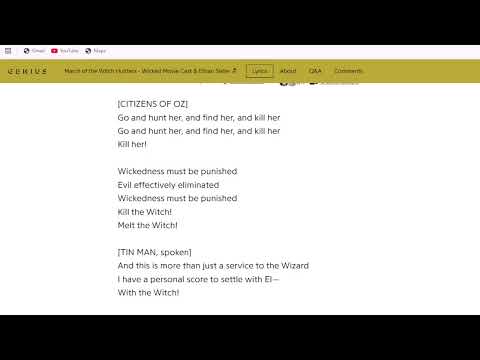
And this is more than just a service to the Wizard
I have a personal score to settle with El—
With the Witch!
[TIN MAN]
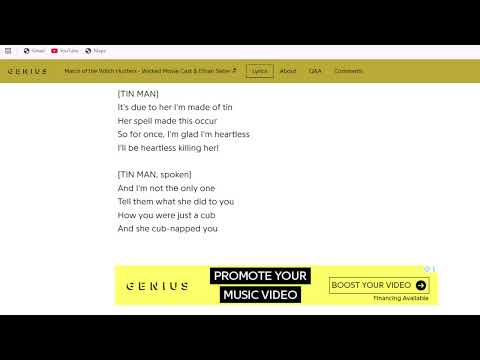
It's due to her I'm made of tin
Her spell made this occur
So for once, I'm glad I'm heartless
I'll bе heartless killing her!
[TIN MAN, spoken]
And I'm not thе only one
Tell them what she did to you
How you were just a cub
And she cub-napped you
See upcoming pop shows
Get tickets for your favorite artists
[TIN MAN]
You see, the lion also
Has a grievance to repay
If she'd let him fight his own battles when he was young
He wouldn't be a coward today
[CITIZENS OF OZ, spoken]
Kill her!
[CITIZENS OF OZ]
Wickedness must be punished
Brave Witch Hunters, I would join you if I could
Because Wickedness must be punished, punished, punished
For good
Kill her, go! Melt her, go! Kill her, go! Melt her, go!
Kill her, go! Melt her, go! Kill her, go! Melt, her, go!
Kill her, go! Melt her, go! Kill her, go! Melt her, go!
Kill her, go! Melt her, go! Kill her!
Melt her!

Wicked: For Good
Soundtrack Lyrics for Movie, 2025
Track Listing
Wicked Movie Cast & Cynthia Erivo (Ft. Ariana Grande & Michelle Yeoh)
Ariana Grande & Wicked Movie Cast (Ft. Michelle Yeoh)
Cynthia Erivo
Marissa Bode, Cynthia Erivo & Ethan Slater
Jeff Goldblum, Cynthia Erivo & Ariana Grande
Ariana Grande
Cynthia Erivo & Jonathan Bailey
Cynthia Erivo
Wicked Movie Cast & Ethan Slater
Ariana Grande
Cynthia Erivo & Ariana Grande
John Powell & Stephen Schwartz, Featuring Ariana Grande & Cynthia Erivo
Stephen Schwartz
Song Overview
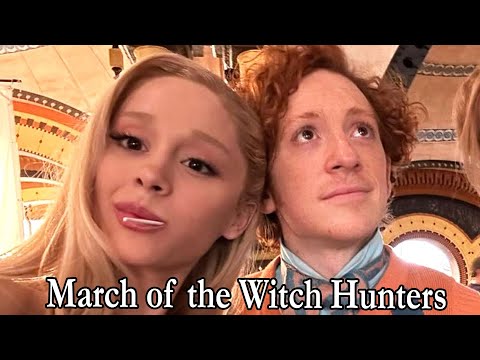
Review and Highlights
Quick summary
- Classic Act 2 mob number from Wicked, adapted for the film sequel Wicked: For Good and performed by Wicked Movie Cast with Ethan Slater as Boq.
- Sits right after No Good Deed in both stage show and movie, launching the final confrontation at Kiamo Ko as the citizens of Oz march on Elphaba.
- Built as a driving, militaristic ensemble piece that mixes Broadway aggression with tight film-score orchestration and modern mixing.
- Gives the Tin Man and the Cowardly Lion explicit backstories, letting them air personal grudges against the so called Wicked Witch.
- On Wicked: For Good - The Soundtrack it appears as track 9, serving as the storm-before-the-finale counterpart to The Girl in the Bubble and For Good.
March of the Witch Hunters (2025) - film soundtrack song - largely diegetic crowd sequence. The track scores the scene in which Boq, now transformed into the Tin Man, rouses the citizens of Oz to storm Kiamo Ko while the Cowardly Lion joins in, their chant echoing through the streets and intercut with Glinda’s mounting alarm. It arrives in the last third of Wicked: For Good, after No Good Deed and before Glinda’s introspective The Girl in the Bubble, setting up the siege that will reshape every character’s fate.
Review
On stage, March of the Witch Hunters has always been the moment where the show bares its teeth. In the film version, that bite is sharpened. The movie leans into the piece as a portrait of collective rage, with the citizens of Oz surging forward in formation while Boq spits out his grievance. According to the Wicked Wiki and several soundtrack guides, the number still sits after No Good Deed and just before the final section at Kiamo Ko, retaining its place as the last big ensemble push before the ending.
Musically, the song is a straight-ahead march in common time. The Broadway recording clocks in around 115 BPM in a bright minor mode, and the new soundtrack cut preserves that sense of forward thrust, even as the orchestration grows larger for film. Driving percussion on snare and bass drum lays down a stomp that feels like boots on cobblestones, while low brass growls around the main chant. It has the clipped, almost percussive vocal writing Stephen Schwartz reserves for his angriest material.
Ethan Slater’s Boq is the focal point this time. Where the original Broadway recording put Christopher Fitzgerald at the center, the 2025 film gives Slater a more prominent vocal spotlight as the Tin Man. NBC’s song breakdown notes that he “gets his moment to shine” here as he charges the crowd, and Billboard’s early ranking of the soundtrack singles out his furious tone as the track’s saving grace. You can hear the metal in his timbre when he spits lines about being “glad I’m heartless” - it is bitter, not jokey.
The orchestral forces documented in the soundtrack credits - full strings, brass, woodwinds, and pounding timpani - are used with some restraint at first. We start in a tight, almost claustrophobic register, with the chant “Go and hunt her, and find her, and kill her” tossed between chorus sections like a call and response. As Boq takes the verse and explains why he blames Elphaba for his transformation, the arrangement opens up: trombones bark accents, trumpets double the upper line, and the chorus returns with greater force, answering his personal grievance with mass fury.
Tonally, this is one of the darkest stretches of the Wicked story. Classic FM’s guide to the part two score points out how the second film pivots into harder shades, and March of the Witch Hunters is one of the clearest examples. There is no wink in the mob; no comic relief cuts the chant. Instead, the track functions almost like a horror march, the kind of piece you could drop into any scene about a crowd turning on an outsider.
Production-wise, Greg Wells and Stephen Oremus keep the sound crisp. The mix lets the crowd vocals stay legible even when they overlap, which is no small feat with this many singers. Low end from tuba and basses rumbles under the voices, while rhythm programming reinforces the tempo without turning it into a rock track. The result is clean enough to sit comfortably on a modern soundtrack playlist, but it still feels driven by live bodies shouting in a room.
Screen & media placement
For the film, the number is staged as a full-blown march through the Emerald City and beyond. Articles from NBC and The Direct describe the sequence: Boq, now fully Tin Man, addresses a crowd of Ozians and reframes his tragic backstory as a rallying cry. The Cowardly Lion, voiced by Colman Domingo, joins in, his own childhood encounter with Elphaba twisted into an excuse for vengeance. The camera reportedly cuts between their march and glimpses of Glinda and the Wizard’s camp, underlining just how far the propaganda campaign has gone.
Unlike some songs that get chopped for runtime, this one survives more or less intact in the adaptation. It functions as the kinetic opposite of The Girl in the Bubble, which follows soon after. Where that track is introspective and static, March of the Witch Hunters is relentless motion - torches, banners, boots, and a mantra of punishment. RadioTimes’ soundtrack preview lists it squarely among the climactic tracks, and the various vinyl track lists confirm its placement just before the last two songs on the album.
Creation History
March of the Witch Hunters goes back to the original 2003 Broadway production, where it was written by Stephen Schwartz as a short, ferocious bridge between Elphaba’s spell-casting in No Good Deed and the show’s final sequences. Fandom entries for both Wicked and the Oz universe describe it as the point where the citizens set off for Kiamo Ko, with Boq and the emerging Cowardly Lion in tow. The Oz Wiki notes the simultaneous offstage discovery Glinda makes about Madame Morrible and the Wizard’s involvement in Nessarose’s death, making this a crossroads scene for multiple arcs.
Schwartz has spoken in his own Q&A materials about how rare outright anger is in his catalog, citing this song alongside “Savages” from Disney’s Pocahontas as two of his most intense outbursts. You can feel that lineage in the way the text frames the “other” as something to be purged and in the sharp, repetitive phrasing. For the film, he and arranger Stephen Oremus expanded the orchestration while keeping the structure familiar, adding more space for percussion and brass hits that suit cinema speakers.
On the soundtrack, the track runs about 2:36, noticeably longer than the 2003 cast album cut, reflecting the extended film sequence. The personnel list from Tidal and the official credits confirms that the same London orchestra used across the Wicked films plays here, under Oremus’ baton, with rhythm programming and bass and guitar overdubs by Greg Wells to toughen the groove. According to NME magazine’s overview of the For Good album, March of the Witch Hunters is one of the returning Act 2 numbers that benefits most from the expanded budget and modern recording approach.
Song Meaning and Annotations
Plot
Within the story, this is the moment when fear finally boils over. The Wizard’s regime and Madame Morrible have spent the whole tale turning Elphaba into a nightmare figure, the Wicked Witch of the West. By the time this song arrives in the second film, propaganda has worked: ordinary citizens are ready to do violence in the name of safety.
The Ozians start the piece with a blunt chant, urging each other to track Elphaba down and “kill” or “melt” her. They are not individuals here; they’re a single, shouting mass. Into that chorus steps Boq, now the Tin Man, who rebrands himself not as a victim of the system but as someone who has a “personal score to settle.” He blames Elphaba’s spell for the fact that he is made of metal, and because of that, he says he is glad to be heartless. His lack of emotional capacity becomes a justification for cruelty.
He then calls on another familiar face: the Lion, whose brief spoken role explains that Elphaba once intervened when he was “just a cub,” stopping him from fighting and thereby, in his mind, robbing him of courage. It is a bitter twist on her earlier compassion. Instead of seeing her as a protector, he recasts her as the cause of his lifelong fear.
The crowd seizes on these grievances. Every line they hear becomes more fuel for the chant that “wickedness must be punished.” The text makes a point of how easily the mob shifts from “service to the Wizard” to personal revenge. By the end of the piece, the citizens of Oz are not just hunting a supposed villain; they are seeking catharsis, hoping that eliminating her will make their own discomfort disappear.
Song Meaning
At its core, March of the Witch Hunters is about mob mentality and scapegoating. The citizens of Oz have been fed a simple story: all their problems can be laid at the feet of a single outsider. The chant’s repetition is both catchy and chilling, as it turns ideology into muscle memory. Once the phrase “wickedness must be punished” is locked into rhythm, it hardly matters whether Elphaba is guilty of the specific crimes they name.
Boq’s verse is crucial. Instead of acknowledging that the Wizard and Morrible orchestrated events that warped his body, he pins everything on Elphaba. It is easier to blame the woman he already fears than to challenge the authority that actually exploited him. His line about being pleased to lack a heart suggests a broader theme in Wicked: when people deny their own capacity for feeling, they are more easily weaponized.
The Lion’s brief contribution adds another layer. His story reframes Elphaba’s kindness - saving a young animal from a cruel test - as a kind of theft. That twist captures how propaganda works on a personal level. Someone who is already ashamed of their fear can be convinced that anyone who reminds them of an earlier vulnerability is an enemy. The song dramatizes that twist in real time, turning history into grievance.
In a broader sense, the number comments on how crowds can be turned into blunt instruments. Schwartz has explored this territory before in “Savages,” which similarly shows a group chanting its way into violence. Here, the musical style is different - more quick-march than war-chant - but the message overlaps: people who feel wronged can be persuaded to commit acts they might never consider on their own once they dissolve into a mob.
Annotations
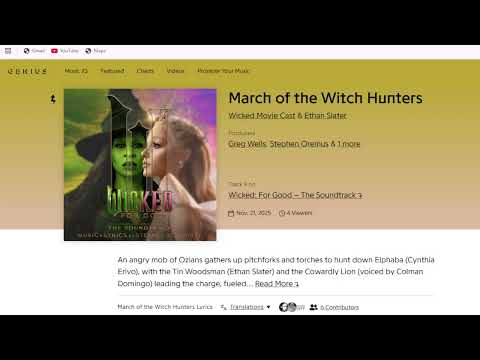
An angry mob of Ozians gathers with pitchforks and torches to hunt down Elphaba, with the Tin Man and the Cowardly Lion leading the charge.
This summary from the official song description captures the visual we expect: classic fairy-tale villagers storming the castle. But in Wicked, that image is layered. These are not faceless extras; they include characters we have followed for two films. Their participation makes the march feel less like an abstract warning and more like a tragic choice by people we know.
The Tin Man frames the hunt as “more than just a service to the Wizard” - it is his chance to settle a personal score.
The spoken lead-in matters. By saying the quiet part aloud, Boq undercuts any claim that this is noble. He is not only enforcing law; he is indulging his resentment. That blend of public duty and private vengeance is a hallmark of ugly politics in the real world, and the song lets us see it in Ozian form.
The Lion’s childhood rescue is rewritten as the moment that doomed him to cowardice.
That idea is heartbreaking if you know the earlier parts of the story. Elphaba intervened to stop cruelty; the Lion now believes he needed that ordeal to become strong. Instead of confronting the system that forces children into dangerous tests, he blames the girl who tried to shield him. It is a small, precise example of how victim narratives can be distorted.
Rhythm, genre, and emotional arc
Stylistically, the piece fuses Broadway choral writing with something close to a militaristic film cue. The stomp at 115 BPM, the snare patterns, and the shouted refrains place it squarely in march territory. At the same time, the choral harmonies, tight internal rhymes, and character-specific asides keep it rooted in musical-theatre storytelling.
The emotional arc (for the listeners, if not for the mob) moves from shock to dread. At first, the chant may even seem darkly thrilling - the kind of thing an audience might clap along to if they were not paying attention. As Boq and the Lion spell out their reasons, though, the tone turns queasier. The more details we hear, the more apparent it becomes that their rage is misdirected.
Metaphors and key phrases
Rather than elaborate metaphor, Schwartz uses blunt, slogan-like phrasing. “Wickedness must be punished” sounds like a policy plank or an official decree; in context, it disguises personal revenge as moral duty. The repeated calls to “melt” Elphaba tap into Oz iconography - melting as the witch’s classic fate - while turning it into a crowd-pleasing spectator sport.
The phrase “for good” slipped into the crowd’s chant is particularly striking. It anticipates the title song and the film’s subtitle, but here it is used in a harsh way: punishment “for good,” as in permanently. Later, the show will flip that phrase into a promise of change and lasting friendship. In this earlier context, the words show how language can be bent toward very different ends.
Cultural and historical echoes
The scene invites obvious comparisons to historical witch hunts and more modern examples of hysteria-driven persecution. Scholars of musical theatre have noted how the original Wicked used Oz as a stand-in for societies that demonize whatever they fear or do not understand. In the film era, critics writing in outlets like Classic FM and ScreenRant have extended that reading, pointing to the way March of the Witch Hunters mirrors online pile-ons and simplistic “good vs evil” rhetoric in contemporary politics.
Technical Information
- Artist: Wicked Movie Cast, Ethan Slater
- Featured: Ensemble vocals by citizens of Oz; Tin Man (Boq) and Cowardly Lion highlighted
- Composer: Stephen Schwartz
- Producer: Greg Wells, Stephen Oremus, Stephen Schwartz
- Release Date: November 21, 2025 (on Wicked: For Good - The Soundtrack)
- Genre: Musical-theatre march, soundtrack
- Instruments: Full orchestra (strings, brass, woodwinds), piano, keyboards, percussion, timpani, tuba, bass, guitar, rhythm programming
- Label: Republic Records, Verve Label Group, Universal Studios partners
- Mood: furious, driven, menacing
- Length: approximately 2 minutes 36 seconds
- Track #: 9 on Wicked: For Good - The Soundtrack
- Language: English
- Album: Wicked: For Good - The Soundtrack
- Music style: Ensemble march with choral chant and character solos
- Poetic meter: Predominantly regular, march-like stress patterns with short, hammering phrases
Questions and Answers
- Who produced March of the Witch Hunters by Wicked Movie Cast and Ethan Slater?
- The track is produced by Greg Wells, Stephen Oremus, and Stephen Schwartz, the same core team responsible for the rest of Wicked: For Good - The Soundtrack.
- When was March of the Witch Hunters released?
- It was released on November 21, 2025 as part of Wicked: For Good - The Soundtrack, coinciding with the film’s theatrical debut.
- Who wrote March of the Witch Hunters?
- Stephen Schwartz wrote both music and words, as he did for the original stage version of Wicked.
- Where does March of the Witch Hunters appear in the film?
- It appears in Act 2, after No Good Deed, when Boq rallies the Ozians to storm Kiamo Ko. The sequence propels the story into its final showdown with Elphaba.
- How is the film version different from the original Broadway cast recording?
- The basic structure and lyric remain, but the film version extends the sequence, deepens the Tin Man’s and Lion’s roles, and uses a larger orchestra and modern mixing. Ethan Slater’s vocal interpretation adds a sharper, more metallic edge to Boq’s verse.
- Is March of the Witch Hunters a standalone single or mainly a soundtrack cue?
- While available as a digital track on streaming platforms, it functions primarily as a soundtrack cue. Its full impact comes when heard in sequence with No Good Deed and the later scenes at Kiamo Ko.
- What does the song reveal about Boq’s character?
- It shows how far he has drifted from the shy, lovestruck Munchkin of Part One. Boq now embraces his transformation into the Tin Man and chooses rage over reflection, directing his pain at Elphaba instead of at the system that harmed him.
- How is the Cowardly Lion introduced through this song?
- The Lion appears as a supporting voice, recalling how Elphaba intervened when he was a cub. That brief story links the Wicked films more tightly to The Wizard of Oz and explains how this Lion came to see himself as cowardly.
- Why is the chant “wickedness must be punished” important?
- It functions as a slogan that flattens nuance. Once the crowd adopts it, they no longer have to question whether their target is actually guilty; they just repeat the phrase and let the rhythm carry them forward.
- What musical elements create the sense of menace in the track?
- The steady 4/4 march at around 115 BPM, heavy low brass, snare drum patterns, and massed unison vocals all work together to evoke a militaristic parade. Occasional dissonant chords in the brass add tension as the crowd’s fury builds.
- Are there official translations of March of the Witch Hunters?
- Licensed lyric platforms host translated text in languages like Thai, reflecting interest in Wicked beyond English-speaking audiences. These translations keep the core chant structure while adapting wordplay for local language rhythms.
- Does the song carry any humor, or is it entirely serious in the film?
- In the film sequel, the tone is far more severe than in some stage productions. Any faint irony in the idea of villagers with pitchforks is overshadowed by the visual of a real mob heading toward a very real execution attempt.
- How do critics view this track within the Wicked: For Good soundtrack?
- Roundups from outlets like NME magazine and Billboard tend to treat it as a crucial bridge rather than a standout single, praising Ethan Slater’s performance and the track’s role in pushing the story into its darkest territory.
Awards and Chart Positions
As of its release window, March of the Witch Hunters itself has not been singled out for major awards. The broader Wicked: For Good - The Soundtrack project, however, has drawn attention in the film-music space. According to the soundtrack’s Wikipedia entry and Hollywood Music in Media Awards listings, the album received nominations in categories for feature-film song and soundtrack, specifically highlighting No Place Like Home and The Girl in the Bubble alongside the album as a whole.
On the chart side, the track functions as part of a strong ensemble rather than as a breakout single. The full album has entered soundtrack and cast-recording charts in multiple territories, with streaming platforms listing March of the Witch Hunters among the key late-album cuts. Services like Spotify and Apple Music group it in curated Wicked playlists, ensuring it sees steady play from fans who run the film’s score in sequence.
How to Sing March of the Witch Hunters
For singers and ensembles, this number is less about vocal beauty and more about precision, stamina, and character. It is short but intense, and in a live setting it can leave you just as winded as a longer showstopper.
Core specs
- Key (original cast reference): A flat or related minor, often played in a dark modal space; many resources list the Broadway cut in Ab-related territory.
- Tempo: around 115 BPM, strict march feel in 4/4.
- Approximate vocal range for Boq: roughly B2 to F4, sitting in a punchy tenor/baritenor zone.
- Style: aggressive musical-theatre march; half-spoken, half-sung declamation over a driving chorus.
Step-by-step approach
1. Lock in the march pulse
Set a metronome to about 115 BPM and clap or stomp along on beats 1 and 3, then on all four beats. Speak the mob chant in time before singing it. The goal is to feel the groove in your body so the rhythmic repetition never drifts.
2. Get the text razor-sharp
This is a text-first song. Work the lines as spoken monologue, focusing on clear consonants and forward vowels. Words like “wickedness,” “punished,” and “heartless” need to cut through a thick ensemble texture. For Boq’s verse, exaggerate the consonants on “tin,” “spell,” and “heartless” without chopping the line.
3. Plan breathing for the crowd sections
In chorus work, stagger breaths so the chant sounds continuous. Mark alternate breathing spots between singers in your section. Avoid everyone lifting at bar lines; instead, trade quick, quiet breaths at different points in the phrase so the sound never collapses.
4. Shape Boq’s verse
For Ethan Slater’s role, think sharp, forward placement with bite. The verse sits mostly in mid-range, so support from the diaphragm is key to keep it ringing over the choir. Treat it like a furious speech on pitch: each phrase should have a clear direction and a destination word that lands right on the beat.
5. Balance shouting with technique
It is tempting to yell. Don’t. Use sob-based support and a slightly bright mix voice to get intensity without strain. Aim for a focused, metallic tone rather than brute volume. Warm up with sirens and gentle belt exercises before tackling the full song.
6. Ensemble blend and dynamics
For the mob, decide where the dynamics crest. The final run of “Kill her, go! Melt her, go!” should feel like an unmistakable peak. Earlier repetitions can sit at mezzo-forte, saving full force for the end. Blend vowels across the group so the crowd sounds like one entity, not a collage of accents.
7. Mic technique (for film-style or amplified performance)
If you are on individual mics, keep Boq close to the capsule during conversational sections and pull slightly away on the most intense lines. For ensemble singers, listen for the snare and low brass in your monitors and sing into that pocket; it will keep the march feeling tight rather than messy.
8. Common pitfalls
- Rushing the chant and creeping above 115 BPM, which robs the march of its weight.
- Letting diction blur in the lower midrange, making the text hard to follow.
- Screaming on the last “Kill her / Melt her” tags, leading to vocal fatigue later in the show.
- Forgetting character: this is not generic anger, but specific frustration redirected into a mob.
Practice materials
Use a rehearsal track or piano reduction in the published key first, then experiment with transposing if needed (many backing-track sites offer multiple keys). Rehearse Boq’s verse a cappella, checking pitch with a piano every few lines. When you add the ensemble, record run-throughs and listen back for togetherness on consonants and the tightness of cutoffs.
Additional Info
It is striking how central March of the Witch Hunters has become to discussions of Wicked’s second film. BroadwayWorld’s deep-dive on For Good and NBC’s song guide both treat it as the moment where the story’s political themes go from subtext to text: the citizens of Oz are no longer just background color, they are the instrument of the Wizard’s power. According to NME magazine’s soundtrack feature, the track helps justify splitting the original stage show into two films by giving the whole back half a sense of mounting momentum.
The song’s transition from stage to screen also gives Ethan Slater a showcase. Teen Vogue and other outlets have covered his journey from Broadway roles to Boq, and he has talked about singing this piece in auditions long before cameras rolled. That familiarity shows. His recorded performance on the soundtrack has the bite of someone who has lived with the material for years but is still finding fresh edges in it.
From a franchise perspective, March of the Witch Hunters is one of the key connecting points between Wicked and The Wizard of Oz. It weaves in the Lion’s origin and echoes the villagers-with-torches imagery that appears, in softer form, in older Oz adaptations. At the same time, the piece feels very twenty-first century in its depiction of information churn and scapegoating. As stated in a recent Rolling Stone study on pop narratives and blame, audiences today are acutely tuned to stories about how anger can be redirected toward easy targets, which may explain why this short, fierce track attracts so much commentary.
Key Contributors
| Subject | Verb | Object |
|---|---|---|
| Stephen Schwartz | wrote | music and words for March of the Witch Hunters |
| Wicked Movie Cast | performed | ensemble vocals on March of the Witch Hunters |
| Ethan Slater | portrayed | Boq and led the march as the Tin Man |
| Stephen Oremus | conducted | the orchestra for Wicked: For Good - The Soundtrack |
| Greg Wells | co produced | March of the Witch Hunters and added rhythm programming |
| Republic Records | released | Wicked: For Good - The Soundtrack in multiple formats |
| Verve Label Group | co released | the soundtrack album for Wicked: For Good |
| Universal Studios | produced | the film Wicked: For Good featuring the song |
| Citizens of Oz (ensemble) | embodied | the mob driving the witch hunt in the film sequence |
Sources: Official Wicked: For Good soundtrack credits and liner notes, Wicked and Oz fan encyclopedias, NBC and BroadwayWorld feature articles on the film’s songs, Classic FM and ScreenRant soundtrack guides, NME magazine’s track-by-track overview, Teen Vogue profile pieces, and Hollywood Music in Media Awards listings.
A-Z Lyrics Universe
Cynthia Erivo Popular
Ariana Grande Horsepower
Post Malone Ain't No Love in Oklahoma
Luke Combs Good Riddance (Time of Your Life)
Green Day Bye Bye Bye
*NSYNC You're the One That I Wan
John Travolta & Olivia Newton-John I Always Wanted a Brother
Braelyn Rankins, Theo Somolu, Kelvin Harrison Jr. and Aaron Pierre The Power of Love
Frankie Goes to Hollywood Beyond
Auli’i Cravalho feat. Rachel House MORE ›