No Good Deed Lyrics – Cynthia Erivo
Soundtrack Album: Wicked: For Good
[ELPHABA – Intro]
Eleka nahmen nahmen, ah tum ah tum, eleka nahmen.
Eleka nahmen nahmen, ah tum ah tum, eleka nahmen.
[Verse 1 – Spell]
Let his flesh not be torn,
Let his blood bear no stain.
And if they beat him —
Let him feel no pain.
Let his bones never break,
And however they try to destroy him —
Let him never die.
Let him never die.
Melkin… Melkin… Melkin…
[Verse 2 – Panic]
What good is this chanting?
I don’t even know what I’m reading.
I don’t even know
Which spell I ought to try.
Fear… where are you?
I'm already trembling, bleeding —
One more disaster
I can add to my generous supply.
[Chorus – No Good Deed]
No good deed goes unpunished.
No act of charity goes unresented.
No good deed goes unpunished —
That’s my new creed.
My noble intentions
Blew up with such a worldly speed.
No good…
No good…
No good deed…
Wicked… through and through.
[Verse 3 – Names]
Doctor Dillamond.
Fiyero.
Oh — one question hurts and haunts:
Too much, too much to mention.
Were they really seeking good
Or just seeking attention?
He said all good deeds are
When looked at with an ice-cold eye…
He said all good deeds are —
Maybe that’s the reason why…
[Bridge]
All good deeds cause endless storms,
All good intentions end up stranded.
All good deeds cause endless swarms
Of sorrow left unhanded.
[Final Chorus]
Well then — let all of us agree:
I’m wicked through and through.
Since I cannot succeed
At saving you…
I promise —
No good deed will I attempt
To do again.
Never again.
No good deed…
Will I do…
Again.

Wicked: For Good
Soundtrack Lyrics for Movie, 2025
Track Listing
Wicked Movie Cast & Cynthia Erivo (Ft. Ariana Grande & Michelle Yeoh)
Ariana Grande & Wicked Movie Cast (Ft. Michelle Yeoh)
Cynthia Erivo
Marissa Bode, Cynthia Erivo & Ethan Slater
Jeff Goldblum, Cynthia Erivo & Ariana Grande
Ariana Grande
Cynthia Erivo & Jonathan Bailey
Cynthia Erivo
Wicked Movie Cast & Ethan Slater
Ariana Grande
Cynthia Erivo & Ariana Grande
John Powell & Stephen Schwartz, Featuring Ariana Grande & Cynthia Erivo
Stephen Schwartz
Song Overview
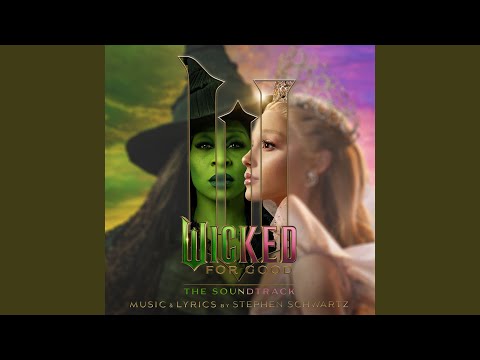
Review and Highlights
Quick summary
- Second-act solo for Elphaba in the film Wicked: For Good, performed by Cynthia Erivo on Wicked: For Good – The Soundtrack (2025).
- New screen arrangement of Stephen Schwartz’s 2003 stage song originally introduced by Idina Menzel in Wicked.
- Produced by Stephen Schwartz, Greg Wells, and Stephen Oremus, with a large studio orchestra recorded for the two-part film adaptation.
- Serves as the turning point where Elphaba declares herself “wicked through and through,” accepting the role the world forces on her.
- Erivo’s take leans into operatic intensity and modern film scoring, with a slightly expanded cinematic build compared to the Broadway cast recording.
Key takeaways: the track preserves the ferocity of the original stage number, adds a more expansive, filmic orchestral sheen, and centers Cynthia Erivo’s voice as a dramatic instrument, pivoting the story from wounded idealism to declared defiance.
Screen & Media Placements
Wicked: For Good (2025) - feature film - diegetic. Performed on screen by Elphaba at her Kiamo Ko hideout, late in the film, as torches blaze and flying monkeys crowd the frame (roughly deep into the third act). The number functions as Elphaba’s true “heel turn”: she reels from Fiyero’s capture and the propaganda of Oz, then decides to embrace the monster label and unleash her power, which sets up the final stretch of the story.
Wicked: For Good clip - Cynthia Erivo Sings "No Good Deed" - promo, studio-released film excerpt. Used across social platforms and entertainment sites in the week of release, spotlighting the Kiamo Ko sequence as proof-of-concept for the movie’s darker second act and Erivo’s vocal firepower.
"No Good Deed" reimagined - Cynthia Erivo x Misty Copeland - promo performance piece. A companion video pairs a stripped-back live rendition of the song with a contemporary dance interpretation by Misty Copeland, released digitally ahead of the film. It reframes the number less as a plot beat and more as a stand-alone piece about rage, sacrifice, and consequence, pushing the song into cross-disciplinary performance art territory.
Creation History
On stage, “No Good Deed” arrived in 2003 as Stephen Schwartz’s big second-act aria for Idina Menzel’s Elphaba, conceived as a muscular, almost operatic soliloquy where the orchestra rages as fiercely as the singer. The composer has spoken about building the song like an aria that still lands with a musical-theatre-style ovation at the end - big belt, big hand, big catharsis.
For Wicked: For Good, that same blueprint is filtered through the sensibilities of a modern film musical. The music department - Schwartz, Greg Wells, and Stephen Oremus - has enlarged the orchestral forces considerably compared with the original Broadway pit, recording at a film scoring studio with a full symphonic lineup. The tempo and key align with the stage version’s high-tension profile, but the arrangement leans into widescreen dynamics: more cinematic percussion, deeper brass swells, and textural strings that frame the vocals in a way that suits both Dolby Atmos cinemas and headphones.
Cynthia Erivo steps into a role that has become a vocal rite of passage. Her version respects the architecture of the original - the incantation, the list of failed “good deeds,” the final vow never to attempt one again - while sharpening details for the camera. Lines that once had to reach the back of a Broadway house now have close-up nuance: whispered consonants, tiny breaks in the voice, quick flashes of doubt before the next burst of power. According to several early film reviews, this track emerges as one of the standout sequences in the movie, the moment where the score, performance, and visual storytelling lock together.
Song Meaning and Annotations
Plot
“No Good Deed” lands near the end of Elphaba’s journey. At this point in the story, she has tried again and again to use her magic for what she believes is right - defending sentient Animals, exposing the Wizard’s lies, protecting the people she loves. Each attempt has gone wrong in some fresh, spectacular way.
In the film, the song is set at Kiamo Ko, a crumbling fortress where Elphaba hides while Fiyero is captured and tortured elsewhere. The scene begins with her frantic spellcasting, an incantation that sounds more like a desperate prayer than an elegant piece of magic. She calls on powers she barely understands to shield Fiyero from pain, to keep his body from breaking and his life from being taken. When the spell seems to fail, the floor falls out from under her sense of purpose.
From there, the song moves through a catalogue of losses: Doctor Dillamond, silenced and removed; Nessarose, who becomes collateral damage in a political game; Fiyero, now suffering because of his choice to stand with her. By the time Elphaba reaches the central refrain, she has come to believe that every attempt to do the right thing has only tightened the noose around the people she cares for.
The turning point is brutal and clean. After asking whether she was ever really seeking good or just seeking attention, Elphaba decides that the world’s conclusion about her must be the truth. If they insist she is wicked, then wicked is what she will be. The last section is half vow, half curse: no more good deeds, no more compromise, no more trying to earn forgiveness from a society determined to hate her.
Song Meaning
At its core, “No Good Deed” is a meditation on burnout in the face of structural injustice. Elphaba has watched a corrupt system twist her best efforts into new forms of harm. The repeated idea that “no good deed goes unpunished” is not just a cynical proverb here - it becomes her lived experience. Each attempt to intervene is seized and weaponised by those in power.
The verses pose a painful question: was she seeking justice, or was there a streak of ego in her quest to be the one who fixes everything? That line about “just seeking attention” cuts right through the usual hero narrative of the chosen one. It suggests that even righteous action can be tangled up with vanity, and that recognising this can feel unbearable.
What follows is a psychological flip. Once Elphaba accepts the label of “wicked,” she frees herself from the exhausting task of trying to look virtuous in the eyes of Oz. On one level, this is tragic - it shows how relentless vilification can push someone into becoming what their enemies always claimed they were. On another, it carries a thread of liberation: she no longer has to contort herself to fit respectable rules that were never designed with her in mind.
In the film, Cynthia Erivo’s delivery heightens that paradox. The power in her high notes reads as fury, but underneath is grief and a weird kind of clarity. The orchestration rises behind her, not as a triumphant fanfare, but as a storm system finally breaking. Critics have singled out this performance as a summit of the movie’s darker arc, and with good reason - it is where the ideology of Oz and the personal cost to Elphaba collide most violently.
Annotations
Missing from the beginning of this version is the line “Fiyero!” which was yelled by Idina Menzel in the original stage song.
On Broadway, “No Good Deed” opens with a raw shout of “Fiyero!” that tumbles straight into the spell. In the film, that cry is repositioned: Glinda screams his name in an earlier moment, and the story cuts into Elphaba’s spellcasting at Kiamo Ko. That structural change does two things. First, it ties Fiyero’s capture more directly to Glinda’s choices, so the later confrontation between them has a sharper sting. Second, it lets Erivo’s Elphaba enter the song already mid-incantation, like we are dropping into the middle of a dangerous ritual rather than watching it begin.
The passage “All right, enough, so be it / So be it then / Let all Oz be agreed / I’m wicked” is performed more as spoken text than a fully sung phrase.
This spoken-style section is crucial. By shifting briefly from full-throated singing to something closer to speech, the arrangement mirrors Elphaba’s thought process snapping into a new shape. The effect in the film is almost like hearing her sign a contract aloud: she accepts the word “wicked,” but on her own terms. Erivo leans into the rhythm of the consonants here, then launches back into sung lines with even more impact. That contrast makes the final vow - “No good deed will I attempt to do again” - feel like a legal clause she is etching into the story of Oz.
Music, rhythm, and vocal design
Musically, “No Good Deed” is a storm in 4/4 time, typically sitting around the mid-fast 110–120 BPM range, with the main Broadway chart in F sharp major while many vocal resources describe it in a minor-centered key for practice purposes. The Cynthia Erivo recording clocks in at about 3:50, slightly longer than the original cast album version, which leaves extra space for cinematic underscoring and breaths.
The vocal writing is built for a high-powered mezzo or soprano with strong belting technique. Various coaching sites and theatre resources place the song’s working range roughly between the lower middle of the staff and ringing top notes around C sharp or beyond, with particular focus on the sustained high climaxes. The famous “Fiyero” sequence, where the name is repeated and ramped upward, has become a playground for “option up” choices - some Elphabas keep to the score, while others push the note even higher as a signature flourish. In Erivo’s hands, the line feels less like a trick note and more like a scream shaped into pitch.
Schwartz’s own commentary on the song often compares it to an aria from the operatic tradition: long, arching phrases, clear psychological progression, and dynamic extremes where a held note collapses suddenly into pianissimo. That operatic ambition is amplified by the Wicked movie orchestra, which folds in lush strings, martial brass hits, timpani rolls, and undercurrents of low winds. The result is a hybrid style: Broadway harmonic language, rock-leaning belt technique, and a film-score sense of space.
Symbols, phrases, and cultural touchpoints
The title phrase, “no good deed goes unpunished,” has lived for decades as a bitter proverb about the risks of altruism. In this context, it becomes a thesis statement for how Oz treats those who try to challenge its injustices. The lyric “Was I really seeking good or just seeking attention?” taps into a debate that feels very 21st century: when activists, influencers, or public figures speak out, how much of it is genuine care, and how much is self-branding? The song quietly acknowledges that those motives can coexist in messy ways.
There are also clear echoes of classic literary and film villains who are not born evil but pushed into it - think of the tragic flips in stories like Phantom of the Opera or even some interpretations of Darth Vader. “No Good Deed” belongs to that tradition, but with the twist that Elphaba is right about the corruption in Oz. Her “villain” turn is not delusion; it is a response to systemic abuse.
Modern commentary around the film has frequently highlighted this number as the cinematic centerpiece of Wicked: For Good, the moment when the fairy-tale imagery collides with real-world themes of scapegoating, propaganda, and burnout. In interviews and previews, the creative team and former stage Elphabas alike have spoken about their anticipation for how this song would translate to the screen, and early coverage from outlets like People and Billboard has treated each new clip as an event in itself.
Technical Information
- Artist: Cynthia Erivo (lead vocal), with Stephen Schwartz and Greg Wells as key creative architects.
- Featured: Film orchestra conducted by Stephen Oremus; large ensemble of session players.
- Composer: Stephen Schwartz.
- Lyricist: Stephen Schwartz.
- Producer: Stephen Schwartz, Greg Wells, Stephen Oremus.
- Release Date: November 21, 2025.
- Genre: Musical theatre, soundtrack, orchestral pop.
- Instruments: Lead vocal, full symphonic strings, brass, woodwinds, harp, piano, keyboards, electric and bass guitar, percussion, timpani, rhythm programming.
- Label: Universal Studios / Republic Records / Verve Label Group.
- Mood: Dark, resolute, furious, tragic, cathartic.
- Length: 3:50 (soundtrack version).
- Track #: 8 on Wicked: For Good – The Soundtrack.
- Language: English (with non-lexical incantation text).
- Album: Wicked: For Good – The Soundtrack (2025).
- Music style: Through-composed dramatic solo with rock-influenced belting and film-score orchestration.
- Poetic meter: Mixed, with conversational verse lines and more regular stress patterns in the refrain.
Questions and Answers
- Who produced “No Good Deed” by Cynthia Erivo?
- The track is produced by Stephen Schwartz, Greg Wells, and Stephen Oremus, continuing the team that has overseen the wider Wicked film music.
- When will Cynthia Erivo release “No Good Deed”?
- The recording is released as part of Wicked: For Good – The Soundtrack on November 21, 2025, the same day the film opens in cinemas.
- Who wrote “No Good Deed” for this version?
- The music and words are by Stephen Schwartz, who first composed the song for the original 2003 Broadway production of Wicked.
- How does Cynthia Erivo’s version differ from Idina Menzel’s original cast recording?
- Structurally, the song follows the same path, but the pacing and orchestration are reshaped for film. Erivo gets more room for intimate, camera-close moments between the big belts, and the spoken lines (“All right, enough, so be it…”) are shaded with subtler acting beats. The orchestra is also larger, with a more cinematic low end and wider stereo image.
- Is “No Good Deed” still the point where Elphaba decides to be “wicked” in the film?
- Yes. The key dramatic beat is intact. The scene still marks Elphaba’s decision to stop chasing approval and to own the “Wicked Witch” identity that propaganda has forced onto her, even though the film gives extra visual context - burning towers, guards closing in, and a sense that the world has already made up its mind.
- Where does the song sit within Wicked: For Good?
- It arrives in the late second-act stretch, after Fiyero has been captured and as Oz tightens its grip. On a typical two-hour-plus running time, it falls well into the final half hour, just before the final confrontations and the story’s resolution.
- How difficult is “No Good Deed” to sing for a working theatre performer?
- Very demanding. The piece asks for stamina, agile breath control, and sustained belting at the top of a mezzo or soprano range, plus the ability to shift from whispered, almost spoken lines to full-voice climaxes. Many Elphabas have cited it as one of the toughest songs in the score, right alongside “Defying Gravity”.
- What is happening emotionally to Elphaba as she sings?
- She is reckoning with the idea that every kind act has blown up in her face. The song tracks a slide from panic to despair to anger to icy resolve. By the end, she has stopped asking for fairness and has chosen to fight on her own terms, no longer pretending to be the public’s idea of “good”.
- Does the incantation at the beginning have a specific translation?
- The phrase “Eleka nahmen nahmen, ah tum ah tum” was written as stylised magical language rather than a direct translation from a real-world tongue. Its meaning is defined less by literal translation and more by the urgency and rhythm of the scene - it is Elphaba throwing everything she has into a protection spell for Fiyero.
- Are there notable other versions or covers of “No Good Deed” connected to this film?
- Beyond countless stage interpretations, the Erivo-led film cycle has already sparked a reimagined performance featuring ballerina Misty Copeland and various promotional clips. Longtime fans also point to earlier stage Elphabas like Jessica Vosk or Willemijn Verkaik as reference points when comparing approaches to the climactic belt and the “Fiyero” riffs.
- How does the song connect to the new originals “No Place Like Home” and “The Girl in the Bubble”?
- Those new songs help flesh out the emotional journeys of Elphaba and Glinda in the film’s second act. “No Good Deed” sits between them as the legacy piece from the original musical - it is the point where Elphaba hits her darkest emotional low, while the new songs deepen the contrast between the friends’ paths.
Awards and Chart Positions
As of release day, the Cynthia Erivo recording of “No Good Deed” is still too new to have a full awards and certifications story of its own. However, the track is part of an aggressively promoted soundtrack campaign. The album Wicked: For Good – The Soundtrack has already drawn industry attention, with early awards buzz centering on the project as a whole and its new songs, while “No Good Deed” is frequently highlighted in reviews as a musical and dramatic high point.
On digital storefronts, the track appears among the stronger-performing songs from the album in various territories. Early download charts show it entering mid-tier positions on national rankings, reflecting both the built-in Wicked fanbase and renewed interest driven by film clips shared across social media.
| Territory / Chart | Metric | Detail (early run) |
|---|---|---|
| Global streaming platforms | Album highlight track | Featured prominently in playlists and “most-played” sections for the soundtrack. |
| Digital song charts | Initial entries | Early download peaks in the lower half of major national charts as listeners sample the full album. |
| Awards conversation | Critical buzz | Frequently cited in film reviews as Cynthia Erivo’s standout performance in the second movie, contributing to awards chatter around her work in the franchise. |
How to Sing No Good Deed
Vocal profile and difficulty
“No Good Deed” is a high-intensity solo that sits in the upper middle of a female voice and pushes toward the top with repeated belts. Many pedagogy and audition resources place its working range roughly from the mid-to-low middle register up to around C sharp or higher, with optional climactic notes that test even seasoned belters. It is best suited to a strong mezzo-soprano or soprano comfortable with rock-influenced musical theatre technique.
The tempo hovers around 115 BPM, fast enough that the text needs crisp diction but slow enough to allow emotional weight on key words. The original stage key centers on F sharp major with a dark, modal flavor; some educational charts list a relative minor key for practice. The film version keeps the feel but benefits from studio mixing, which means the voice rides on top of a dense orchestral bed rather than having to fight it in real time.
Step-by-step practice guide
- Lock in the tempo and pulse. Before worrying about high notes, speak the lyrics in rhythm along with a metronome around 115 BPM. Treat it like dramatic text over a steady heartbeat. Focus on placing consonants cleanly on the beat so that when you sing, the storytelling does not blur.
- Map the tessitura, not just the range. Mark which phrases sit around your “money” notes and which ones climb toward the top. “No good deed goes unpunished” sits in a comfortable belt zone; the “Fiyero” calls and the last “again” push into the edge of your range. Plan breath marks that support those peaks instead of leaving them to chance.
- Build breath support for the long phrases. Practice sustaining neutral vowels (like “ah” or “eh”) on the key climactic pitches for eight counts, then twelve, without squeezing your throat. The goal is to feel support coming from ribs and abdominal engagement rather than neck tension. Once that is stable, plug the real words back in.
- Shape the dynamic arc. The song is not one long scream; it is a series of waves. Mark places where you deliberately back off into quieter, almost spoken delivery (“One question haunts and hurts…”) so that the following swell has somewhere to go. Think in three big climbs: the spell, the self-interrogation, and the final vow.
- Dial in diction on the tongue-twisters. Lines like “My road of good intentions led where such roads always lead” can turn to mush at speed. Practice them as tongue twisters first, then sing them on a lighter mix rather than a full shout, aiming for clarity over volume. Listeners need to understand the words for the song’s philosophy to land.
- Plan your “Fiyero” strategy. Decide early whether you are taking the written notes or any optional “option up” variations you have heard from other Elphabas. Work slowly on the transition from the previous phrase into the first “Fiyero” so that you arrive lined up with the breath and vowel you need. Do not chase someone else’s riff if it does not sit well in your voice.
- Rehearse with reduced orchestration first. Start with piano-only or a soft backing track so you can hear your own resonance and adjust vowels. Once that feels comfortable, move to the full soundtrack or orchestral karaoke. The dense film arrangement can tempt you to over-push; remind yourself that microphones exist, even if you are just singing along at home.
- Integrate acting beats. Take five minutes to speak the text as though it were a monologue, reacting in real time to the images Elphaba names - Fiyero, Doctor Dillamond, Nessarose, the citizens of Oz. Then layer that emotional logic back into the sung version. The performance feels most convincing when the acting choices are as specific as the notes.
- Cool down wisely. After working on this song, do gentle slides, lip trills, or light head-voice patterns to release tension. It is easy to leave your larynx stuck in “battle mode” after those high belts; a short cool-down protects your stamina for the rest of a rehearsal or show.
Practice materials
Useful tools include the original Broadway cast recording, the new Cynthia Erivo soundtrack track, film clips from Wicked: For Good, and a variety of piano or orchestral karaoke accompaniments in different keys. Several vocal-range and sheet-music sites break down the song’s tessitura and offer transposed versions, making it easier to find a key that fits your instrument if you are not aiming to match the exact film pitch.
Additional Info
Even before the second film arrived, “No Good Deed” had acquired a legendary aura among theatre fans. Former Elphabas talk about it as the scene that tests not just their voices but their nerves - it is the moment when the show hands them the full weight of the character’s anger and asks them to hold it for three and a half minutes. With the movie, that legacy now exists in two parallel canons: the stage tradition stretching back to Idina Menzel, and the screen tradition spearheaded by Cynthia Erivo.
According to People magazine’s coverage of Wicked: For Good, cast members and alumni alike have singled out this number as especially cinematic, the kind of sequence that can finally match what fans have always imagined happening inside Elphaba’s head. Billboard has also treated each new “No Good Deed” clip as a headline event, underlining how important this one song is to the perception of the film.
Critics at outlets like Collider and other film sites have pointed to the Kiamo Ko set piece as one of the highlights of the movie, praising not just Erivo’s vocal command but the way the camera and production design frame her as both witch and wounded revolutionary. The flames, the crumbling stone, the circling monkeys - all of it pulls the aria out of the proscenium and into a three-dimensional world, while keeping the emotional focus tightly on her face.
Key Contributors
| Subject | Relation | Object | Type |
|---|---|---|---|
| Cynthia Erivo | performs | Elphaba’s lead vocal on “No Good Deed” in Wicked: For Good | Person |
| Stephen Schwartz | composed and wrote lyrics for | “No Good Deed” | Person |
| Greg Wells | co-produced and arranged | the soundtrack recording of “No Good Deed” | Person |
| Stephen Oremus | music-directed and conducted | the orchestral recording sessions for the song | Person |
| Wicked: For Good \u2013 The Soundtrack | includes | “No Good Deed” as track 8 | CreativeWork |
| Universal Studios / Republic Records / Verve Label Group | released | the soundtrack album featuring this recording | Organization |
| Jon M. Chu | directed | the film Wicked: For Good containing the “No Good Deed” sequence | Person |
| Idina Menzel | introduced | the original Broadway recording of “No Good Deed” as Elphaba | Person |
| Misty Copeland | interprets | a reimagined version of the song through dance in a promotional video | Person |
| Wicked (stage musical) | originated | the song “No Good Deed” in its second act | CreativeWork |
Sources: People, Billboard, Collider, Apple Music, official Wicked: For Good film and soundtrack press notes
A-Z Lyrics Universe
Cynthia Erivo Popular
Ariana Grande Horsepower
Post Malone Ain't No Love in Oklahoma
Luke Combs Good Riddance (Time of Your Life)
Green Day Bye Bye Bye
*NSYNC You're the One That I Wan
John Travolta & Olivia Newton-John I Always Wanted a Brother
Braelyn Rankins, Theo Somolu, Kelvin Harrison Jr. and Aaron Pierre The Power of Love
Frankie Goes to Hollywood Beyond
Auli’i Cravalho feat. Rachel House MORE ›